
About Author

My photo
Professor & HoD Department of Pharmaceutical Chemistry, JSS College of Pharmacy, (Constituent College, JSS Academy of Higher Education &Research-Deemed to be University, Mysuru) Ooty-643 001, The Nilgiris, Tamilnadu,INDIA The author has about 25 years of teaching and research experience. The Author has more than 125 research publications in reputed National and International journals and has H-index 17 by scopus. He has also published 11 books and 12 patents. He is a recognized research guide for Ph.D in JSS Academy of Health Education and Research and He served as editorial member and reviewer in many reputed National and International journals. He is the winner in Drug Discovery Hackathon-2020 for Covid-19 Drug discovery organized by Govt of India and also received a Research grant of 14.35 lakhs in phase-II research. He is nominated as BOS member in various universities and received about 13 awards. He has organized many national and International seminar/ workshop/ Conferences etc sponsored by various funding agencies.

Search This Blog

Monday, September 3, 2018

ISOMERISM


ISOMERISM
v  Isomers are different compounds with the same molecular formula.
v  These compounds are grouped into two broad classes:
      structural isomers and stereoisomers.
v  Structural isomers differ in their bonding sequence; their atoms are connected differently.
v  Stereoisomers have the same bonding sequence but they differ in the orientation of their atoms in space.
v  Stereoisomers often have remarkably different physical, chemical and biological properties. 
Structural isomerism(constitutional isomerism)
Ø   Structural isomerism is the type of isomerism where the molecules are same molecular formula and different arrangement of atoms or groups.
Ø  Types of structural isomerism
  1. chain isomerism, or skeletal isomerism
  2. Position isomerism
  3. Functional group isomerism
  4. Metamerism
  5. Tautomerism
  1. chain isomerism, or skeletal isomerism
Ø  These isomers arise because of the possibility of branching in carbon chains.
Ø  The skeleton are distinctly re-ordered to create different structures. For Example

2.Position isomerism
Ø  In position isomerism, the basic carbon skeleton remains unchanged, but important groups are moved around on that skeleton.
3.Functional group isomerism
Ø  The isomers contain same molecular formula but, different functional groups
Example
                                CH3-CH2-OH          CH3-O-CH3
          Ethyl alcohol            Di methyl ether
4. Metamerism
Ø  This form of isomerism is rare and is limited to molecules having a divalent atom like O or S and alkyl groups around it.
The main examples come from ethers and thioethers.
5.Tautomerism
Ø  This isomerism is due to spontaneous inter conversion of two isomeric forms with different functional groups.
Ø  The prerequisites for this is the presence of the C=O, C==N or N=O in the usual cases and an alpha H atom. 
Ø  Example
Types of Stereoisomers
There are two categories of stereoisomers:
  1. Configurational Isomers:
v  Configurational isomers differ in their arrangement in space and they can not be inter converted without breaking a bond.
v  They are of two types:
  1. Optical isomers         ii. Geometric isomers
B. Conformational Isomers:
They also differ in spatial arrangement of atoms/groups but they can be inter converted easily by rotation around a single bond.
v  Stereoisomers are two types such as Enantiomers & Diastereomers.
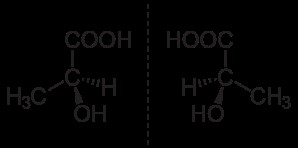
v   Enantiomers, also known as optical isomers, the two stereoisomers that are mirror images of each other that are non-superimposable.
v  Ex-Lactic acid

 v  Diastereomers are stereoisomers not mirror images of each other. These include meso compounds, cistrans (E-Z) isomers, and non-enantiomeric optical isomers. Ex-Tartaric acid


Meso form or meso isomer - A meso form is a stereoisomer of a compound with two or more chiral centers that is superimposable on its own mirror image.
v  Racemic mixture, racemic modification or racemate
v  A mixture consisting of equal amounts of enantiomers.
v  A racemic mixture exhibits no optical activity because the activities of the individual enantiomers are equal and opposite in value, therby canceling each other out.
Optical isomers (+)/(-)
v  Compounds with chiral carbons mainly produce optical isomerism.A molecule with n chiral atoms may have up to 2n stereoisomers.
v   A carbon atom attached to four different atoms or groups is known as asymmetric or chiral carbon.
v  Identifies rotation under plane-polarized light
v  The substance which rotate the plane of polarized light to the right (or clockwise direction) are called dextrorotatory(+), from the Greek word dexios, meaning “toward the right” while those which rotate to the left (or in the anticlockwise direction) are called laevorotatory(-)
Geometrical isomerism
v  Stereoisomerism about double bonds arises because rotation about the double bond is restricted.
v  The geometrical isomers often show different physical and chemical properties.
v  There are two types
                                                                                                                                                             Cis isomer              – identical groups on same side
                            Trans isomer         – identical groups on opposite sides.
v  Usually the dipole moment of cis-isomers is greater than that of trans isomers. Hence the cis isomers usually have more solubility in polar solvents.
v  In general, the trans isomers are more stable than cis isomers.

E-Z NOTATION
v  The simple convention of denoting the geometrical isomers by cis/trans descriptors is not sufficient when there are more than two different substituents on a double bond.
v  To differentiate the stereochemistry in them, a new system of nomenclature known as the E-Z notation method is to be adopted.
v  According to this method, if the groups with higher priorities are present on the opposite sides of the double bond, that isomer is denoted by E.
v   Where E = Entgegen  ( the German word for 'opposite')
v  However, if the groups with higher priorities are on the same side of the double bond, that isomer is denoted by Z.
v   Where Z = Zusammen (the German word for 'together')
v  The letters E and Z are represented within parentheses and are separated from the rest of the name with a hyphen. 

Conformational Isomers:
Conformational isomerism is a form of isomerism that describes the the same structural formula but with different shapes due to rotations about one or more bonds. 
R/S  NOMENCLATURE SYSTEM (Cahn–Ingold–Prelog convention)
v   Assign priorities to the atoms directly attached to the chirality center. The highest priority goes to the atom with the highest atomic number.
v  In case there are isotopes, use the mass number instead, since they have the same atomic number.
v  If two or more of the atoms directly attached to the chiral center are of the same type, look at the next atom to break the tie. Do not do this unless there is a tie. Repeat this process until the tie is broken.
v  For examples
v  When assigning absolute configuration to a chiral carbon the lowest priority group that’s attached to chiral carbon must be pointing away.
v  In the 3-D formula, the groups above the plane is represent as thick line and groups below the plane is represent as dotted line.
To determine whether R or S, find the direction of the priority groups numbered 1-3.
1. (R)- priority #1-3 are clockwise
2. (S)- priority #1-3 are anti- clockwise


v  The 3-D structures are converted in to Fischer formulas by draw the cross with the four substituents attached to the chiral carbon, making sure the lowest priority group is lying on a horizontal line.

v  Now let’s consider the case of chiral molecules that contain two or more stereo centers.
v   Such molecules can have enantiomers because they are not the same as their mirror images.
v  Meso forms can also be open chain, as illustrated below.
v  Different conformations can have different energies, can usually interconvert, and are very rarely isolatable.
v  For example, cyclohexane can exist in a variety of different conformations including a chair conformation and a boat conformation.

Friday, August 24, 2018

Melting Point, Boiling point, Solubility


Boiling point
            The boiling point of an element or a substance is the temperature at which the vapor pressure of the liquid equals the environmental pressure surrounding the liquid.
             The boiling point of a liquid varies dependent upon the surrounding environmental pressure. Different liquids (at a given pressure) boil at different temperatures. A liquid in a vacuum environment has a lower boiling point than when the liquid is at atmospheric pressure. A liquid in a high pressure environment has a higher boiling point than when the liquid is at atmospheric pressure.
            The normal boiling point of a liquid is the special case in which the vapor pressure of the liquid equals the defined atmospheric pressure at sea level, 1 atmosphere. At that temperature, the vapor pressure of the liquid becomes sufficient to overcome atmospheric pressure and lift the liquid to form bubbles inside the bulk of the liquid. The standard boiling point is now defined by IUPAC as the temperature at which boiling occurs under a pressure of 1 bar.
            The heat of vaporization is the amount of energy required to convert or vaporize a saturated liquid (i.e., a liquid at its boiling point) into a vapor.
            Liquids may change to a vapor at temperatures below their boiling points through the process of evaporation. Evaporation is a surface phenomenon in which molecules located near the liquid's edge, not contained by enough liquid pressure on that side, escape into the surroundings as vapor. On the other hand, boiling is a process in which molecules anywhere in the liquid escape, resulting in the formation of vapor bubbles within the liquid.
Determination of Boiling Points
·  Boiling point is determined by Capillary tube method.
·  In this method, a few drops of  liquid are placed in a thin walled small test tube.
·  A capillary tube sealed at about 1 cm from one end, is dropped in to it.
·  A glass tube containing the liquid and capillary, is then tied along a side of thermometer so that the liquid stands just near the bulb.
·  The thermometer is then lowered in a beaker containing paraffin oil.
·  The beaker is heated and the bath liquid stirred continuously using with stirrer.
·  When the boiling point reached, bubbles come from lower end of capillary.
·  The read the temperature from thermometer when the evaluation of bubbles just stop.


Melting Point
            The melting point of a substance is the temperature at which the solid phase converts to the liquid phase under 1 atmosphere of pressure.
            The melting point is one of a number of physical properties of a substance that is useful for characterizing and identifying the substance.
            To measure the melting point of a substance, it is necessary somehow to gradually heat a small sample of the substance while monitoring its temperature with a thermometer. The temperature at which liquid is first seen is the lower end of the melting point range. The temperature at which the last solid disappears is the upper end of the melting point range. A pure substance normally has a melting point range no larger than 1-1.5 oC.
            Although many substances melt cleanly and can be melted, crystallized, and remelted repeatedly without chemical decomposition, others chemically decompose before they melt, forming substances of lower molecular weight.
            The temperature at which the color change is first observed signals that the substance is approaching the decomposition temperature.
Determination of Melting Points
·  Melting point is also determined by Capillary tube method.
· A glass capillary tube which is 5-6 cm long and 1mm diameter, normally used to contain the sample for a melting point determination.
·  The tube must have one open end into which the sample can be loaded, and one sealed end so that the capillary will retain the solid sample.
·  The substance should stand in the capillary 3-4 mm from the bottom when thoroughly packed.
· The capillary is wetted with liquid in the bath and then tied along a side of thermometer fixed in an iron stand.
· The thermometer is then lowered in a beaker containing paraffin oil.
· The beaker is heated and the bath liquid stirred continuously using with stirrer.
·  When the substance in the capillary just shows sign of melting , the burner is removed and stirring continued.
· The read the temperature from thermometer when the substance melts and become transparent. This is the melting point range of that substance.

Solubility

Ø  A solution is a homogeneous mixture of two or more substances.
Ø  A solute is defined as the substance that dissolves in a solution.
Ø  A solvent is defined as the material that dissolves the other substance(s) in a solution. It is the dissolving medium.
Ø  Solubility is defined as the maximum amount of a substance (solute) which will dissolve in a given amount of solvent at a specific temperature.
            Solubility is the property of a solid, liquid, or gaseous chemical substance called solute to dissolve in a liquid or gaseous solvent to form a homogeneous solution of the solute in the solvent.
            The solubility of a substance depends on the used solvent as well as on temperature and pressure. The extent of the solubility of a substance in a specific solvent is measured as the saturation concentration where adding more solute does not increase the concentration of the solution.
            The solvent is generally a liquid, which can be a pure substance or a mixture. The extent of solubility ranges widely, from infinitely soluble such as ethanol in water, to poorly soluble, such as silver chloride in water. The term insoluble is often applied to poorly or very poorly soluble compounds.
            Under certain conditions the equilibrium solubility can be exceeded to give a so-called supersaturated solution, which is metastable.
            According to an IUPAC definition, solubility is the analytical composition of a saturated solution expressed as a proportion of a designated solute in a designated solvent. Solubility may be stated in units of concentration, molality, mole fraction, mole ratio, and other units.

Factors affecting solubility

            The solubility of one substance in another is determined by the balance of intermolecular forces between the solvent and solute, and the entropy change that accompanies the solvation. Factors such as temperature and pressure will alter this balance, thus changing the solubility.
            Solubility may also strongly depend on the presence of other species dissolved in the solvent, for example, complex-forming anions (ligands) in liquids.
Solubility will also depend on the excess or deficiency of a common ion in the solution, a phenomenon known as the common-ion effect. Solubility will depend on the ionic strength of solutions.

Temperature

            The solubility of a given solute in a given solvent depends on temperature. For many solids dissolved in liquid water, the solubility increases with temperature up to 100 °C. In liquid water at high temperatures, the solubility of ionic solutes tends to decrease due to the change of properties and structure of liquid water; the lower dielectric constant results in a less polar solvent.
            The chart shows solubility curves for some typical solid inorganic salts (temperature is in degrees Celsius). Many salts behave like barium nitrate and disodium hydrogen arsenate, and show a large increase in solubility with temperature. Some solutes (e.g. NaCl in water) exhibit solubility which is fairly independent of temperature. A few, such as cerium(III) sulfate, become less soluble in water as temperature increases. This temperature dependence is sometimes referred to as "retrograde" or "inverse" solubility.
            The solubility of organic compounds nearly always increases with temperature. The technique of recrystallization, used for purification of solids, depends on a solute's different solubilities in hot and cold solvent. A few exceptions exist, such as certain cyclodextrins.

Pressure

            For condensed phases (solids and liquids), the pressure dependence of solubility is typically weak and usually neglected in practice. Assuming an ideal solution, the dependence can be quantified as:
            The pressure dependence of solubility does occasionally have practical significance. For example, precipitation fouling of oil fields and wells by calcium sulfate (which decreases its solubility with decreasing pressure) can result in decreased productivity with time.

 Polarity

            A very polar (hydrophilic) solute such as urea is very soluble in highly polar water, less soluble in fairly polar methanol, and practically insoluble in non-polar solvents such as benzene. In contrast, a non-polar or lipophilic solute such as naphthalene is insoluble in water, fairly soluble in methanol, and highly soluble in non-polar benzene.
            The solubility is favored by entropy of mixing and depends on enthalpy of dissolution and the hydrophobic effect.

 Applications

            Solubility is of fundamental importance in a large number of scientific disciplines and practical applications, ranging from ore processing, to the use of medicines, and the transport of pollutants.
            Solubility is often said to be one of the "characteristic properties of a substance," which means that solubility is commonly used to describe the substance, to indicate a substance's polarity, to help to distinguish it from other substances, and as a guide to applications of the substance. For example, indigo is described as "insoluble in water, alcohol, or ether but soluble in chloroform, nitrobenzene, or concentrated sulfuric acid".
            Solubility of a substance is useful when separating mixtures. For example, a mixture of salt (sodium chloride) and silica may be separated by dissolving the salt in water, and filtering off the un dissolved silica.
            Another example of this is the synthesis of benzoic acid from phenyl magnesium bromide and dry ice. Benzoic acid is more soluble in an organic solvent such as dichloromethane or diethyl ether, and when shaken with this organic solvent in a separatory funnel, will preferentially dissolve in the organic layer. The other reaction products, including the magnesium bromide, will remain in the aqueous layer, clearly showing that separation based on solubility is achieved. This process, known as liquid-liquid extraction, is an important technique in synthetic chemistry.

Solubility of ionic compounds in water

            Some ionic compounds (salts) dissolve in water, which arises because of the attraction between positive and negative charges. For example, the salt's positive ions (e.g. Ag+) attract the partially-negative oxygens in H2O. Likewise, the salt's negative ions (e.g. Cl) attract the partially-positive hydrogens in H2O.
AgCl(s) Ag+(aq) + Cl(aq)
However, there is a limit to how much salt can be dissolved in a given volume of water. This amount is given by the solubility product, Ksp. This value depends on the type of salt (AgCl vs. NaCl), temperature, and the common ion effect.

Solubility of organic compounds

            The principle of polarity, that like dissolves like, is the usual guide to solubility with organic systems. For example, petroleum jelly will dissolve in gasoline because both petroleum jelly and gasoline are non-polar hydrocarbons. It will not, dissolve in ethyl alcohol or water, since the polarity of these solvents is too high. Sugar will not dissolve in benzene, since sugar is too polar in comparison with benzene.

Solubility in non-aqueous solvents

            Non polar solutes are soluble in non aqueous solvents. Most available solubility values are those for solubility in water. The reference also lists some for non-aqueous solvents.

 Quantification of solubility

            Solubility is commonly expressed as a concentration, either by mass (g of solute per kg of solvent, g per dL (100mL) of solvent, molarity, molality, mole fraction or other similar descriptions of concentration.
Density
            Density is the measure of the mass per unit volume of a material (density = mass/volume). Density is a characteristic of a substance. Mass and volume vary with size but density will remain constant. Temperature will affect the density of a substance.

 Molarity
            A useful way to express exact concentrations of solutions is molarity. Molarity is defined as moles of solute per litre of solution. Molarity is symbolized by the capital letter M. It can be expressed mathematically as follows.

Molarity (M)   =          moles of solute (n)
Liters of solution (V)

            Notice that the moles of solute are divided by the liters of solution not solvent. One litre of one molar solution will consist of one mole of solute plus enough solvent to make a final volume of one litre.

Normality
            The normal concentration is another method for expressing the concentration of solutions.
            Normality (N) is defined as the number of equivalents of solute dissolved in one litre of solution.
            One equivalent of acid is the amount of acid necessary to give up one mole of hydrogen ions in a chemical reaction. One equivalent of base is the amount of base that reacts with one mole of hydrogen ions. When expressing the concentrations of bases, normality refers to the number of available hydroxyl ions. Because hydrogen and hydroxyl ions combine on a one-to-one basis, one OH- is equivalent to one H+ ion.

            ppm expresses the concentration of a solution in units of one part of solute to one million parts solvent. One ppm equals one milligram of solute per litre of solution.

INTERMOLECULAR FORCES


INTERMOLECULAR FORCES
  • Inter molecular forces are the attraction between the molecules. It is a weak bond.
  • Attractions exerted by one molecule on another, such as the force of attraction between water molecules in ice.
  • Attractions between atoms of the noble gas elements, helium through radon.
  • Attractions between molecules of one substance and molecules of another, as when two liquids are mixed, or a molecular solid such as sugar is dissolved in a liquid.
  • Attraction between molecules of one substance and ions of another, as when an ionic compound dissolves in a liquid.
            Intermolecular forces (forces between two molecules) are weak compared to the intramolecular forces (forces keeping a molecule together). For example, the covalent bond present within HCl molecules is much stronger than the forces present between the neighbouring molecules. These forces exist between molecules when they are sufficiently close to each other. The forces consist of following types:
  1. Dipole-dipole interactions
  2. Hydrogen bonds
  3. Dispersion forces
  4. Vander walls forces
  5. Ion–dipole forces
6. Instantaneous dipole-induced dipole forces or London dispersion forces.

Dipole–dipole interactions

            Dipole–dipole interactions are electrostatic interactions of permanent dipoles in molecules. These interactions tend to align the molecules to increase the attraction (reducing potential energy).
An example of a dipole–dipole interaction can be seen in hydrogen chloride (HCl):
            The positive end of a polar molecule will attract the negative end of the other molecule and cause them to be arranged in a specific arrangement. Polar molecules have a net attraction between them. For example HCl and chloroform (CHCl3)
            Intermolecular forces that operate between neutral molecules having molecular dipole moments are called dipole-dipole forces. The dipole moments of two neighbouring molecules tend to align with the + end of one dipole near the - end of the other, so that forces of attraction between them are maximized.
            Such forces are obviously much weaker than those operating in ionic or covalent network solids, and give rise to potential wells having depths in the approximate range 5-20 kJ/mole. Many molecular substances with dipolar molecules exist as liquids at ambient temperature, and have relatively low boiling points. In particular, many organic compounds are of this type.
·         For Ex - SiF4, CHCl3, CO2, SO2 experience dipole-dipole intermolecular forces.

Hydrogen bonding

            Hydrogen bond is the strong dipole-dipole attractions between hydrogen atoms bonded to small, strongly electronegative atoms (O, N, or F) and nonbonding electron pairs on other electronegative atoms.
1) Bond dissociation energy of about 4-38 KJ mol–1 (0.96-9.08 Kcal mol–1).
2) H-bond is weaker than an ordinary covalent bond; much stronger than the dipole-dipole interactions.
3) Hydrogen bonding accounts for the much higher boiling point (78.5 °C) of ethanol than that of dimethyl ether (–24.9 °C).
4) A factor (in addition to polarity and hydrogen bonding) that affects the melting point of many organic compounds is the compactness and rigidity of their individual molecules.
            Adjacent molecules of the compound containing an O-H bond will be attracted to each other by virtue of these opposite charges. This force of attraction is known as the Hydrogen Bond. Usually a hydrogen bond is represented by a dotted line (Fig. 5.39).
            Intermolecular hydrogen bonding is responsible for the high boiling point of water (100°C) compared to the other hydrides that have no hydrogen bonds. Intra molecular hydrogen bonding is partly responsible for the secondary, tertiary, and quaternary structures of proteins and nucleic acids. It also plays an important role in the structure of polymers, both synthetic and natural. Hydrogen bond forces cause potential wells of depth in the range 5-50 kJ/mole.
 Examples  -  CHCl3, CH3CH2OH, HNO3, PH3
            It is understandable that substances having nearly the same molecular weights, have the same boiling point. The boiling points of alkanes and ethers of comparable molecular weights are not far apart, but the boiling points of alcohols having almost equal molecular weights are considerably higher.
            This can be explained on the basis of hydrogen bonding. Ethanol forms hydrogen bonds. Extra energy in the form of heat is required to break the hydrogen bonds holding the molecules together before it can be volatilized. Propane and dimethyl ether do not form hydrogen bonds and, therefore, have low boiling points.
Effect on Water-Solubility. A hydrogen-bonded substance is usually soluble in another hydrogen bonded substance.
            For example, alcohols are soluble in water but alkanes are not. This is because a non polar alkane molecule cannot break into the hydrogen bonded sequence in water . It Cannot replace the hydrogen bonds that would have to be broken to let it in.
            An alcohol molecule is capable of hydrogen bonding. It can slip into the hydrogen bonded sequence in water. It can replace the hydrogen bonds that must be broken to let it in.
            Thus alcohols of low molecular weight are water soluble. However, when the alkyl group is four or more carbons in length the alkane nature of the molecule predominates, and water solubility fans off sharply. Alcohols containing more than seven carbons are insoluble in water.

London dispersion forces

            Otherwise known as quantum-induced instantaneous polarization or instantaneous dipole-induced dipole forces, the London dispersion force is caused by correlated movements of the electrons in interacting molecules. The electrons, which belong to different molecules, start "feeling" and avoiding each other at the short intermolecular distances, which is frequently described as formation of "instantaneous dipoles" that attract each other.

Debye (induced dipole) force

            The induced dipole forces appear from the induction (also known as polarization), which is the attractive interaction between a permanent multipole on one molecule with an induced (by the former di/multi-pole) multipole on another. This interaction is called Debye force after Peter J.W. Debye.
            The example of an induction-interaction between permanent dipole and induced dipole is HCl and Ar. In this system, Ar experiences a dipole as its electrons are attracted (to H side) or repelled (from Cl side) by HCl. This kind of interaction can be expected between any polar molecule and non-polar/symmetrical molecule. The induction-interaction force is far weaker than dipole-dipole interaction, however stronger than London force.
Van der Waals Forces
            In addition to chemical bonding between atoms, there is another type of attractive force that exists between atoms, ions, or molecules known as van der Waals forces.
            These forces occur between the molecules of non polar covalent substances such as H2, Cl2 and He. These forces are generally to be caused by a temporary dipole, or unequal charge distribution, as electrons constantly move about in an atom, ion, or molecule. At a given instant, more electrons may be in one region than in another region, as illustrated in Figure.
            The temporary dipole induces a similar temporary dipole on a nearby atom, ion, or molecule. Every instant, billions of these temporary dipoles form, break apart, and reform to act as a weak electrostatic force of attraction known as van der Waals forces.
            It is important to note that van der Waals forces exist between all kinds of molecules. Some molecules may have these forces, as well as dipole or other intermolecular forces. Therefore, the strength of the van der Waals forces between substances increases with increasing gram molecular mass.

Rearrangement Reactions